The Real Danger of Using Boom Lifts on Masonry Restoration Projects (And Why Many Contractors Still Get It Wrong)
Boom lifts have become the lazy default on too many masonry restoration projects. They’re fast. They’re convenient. They reduce setup time. And they quietly introduce catastrophic risk when used by crews who don’t fully understand masonry environments.
This isn’t a generic construction safety issue. Boom lifts behave very differently when used around historic masonry, unstable substrates, narrow access points, and aging urban infrastructure. Contractors who treat them like universal tools are gambling with lives, liability, and reputations.
Let’s be precise about the dangers.
Tip-Over Risk: Physics Doesn’t Care About Your Schedule
Boom lifts are inherently unstable machines: narrow footprint, high center of gravity, long leverage arm. Add masonry site conditions and you multiply the hazard.
Common restoration environments include:
- Settled or undermined ground near foundations
- Vaulted sidewalks and hollow sidewalks in historic cities
- Backfilled trenches alongside buildings
- Sloped terrain around churches, towers, and civic buildings
- Deteriorated paving that looks solid but isn’t
One minor shift in load, one soft spot in soil, one unrecognized void—and the machine goes over. Not slowly. Not politely. Violently.
Tip-overs are one of the leading causes of serious injury and death involving aerial lifts. Anyone pretending otherwise either hasn’t studied accident reports or is willfully ignoring them.
Overhead Power Lines: The Most Predictable Fatality in Construction
Electrocution isn’t an “unfortunate possibility.” It’s a recurring pattern.
Masonry restoration frequently takes place in:
- Dense urban corridors
- Alleyways with service drops
- Church properties with poorly documented wiring
- Historic districts with outdated electrical routing
Boom lifts don’t need to touch the line to kill you. Arcing can occur without contact. Operators who assume clearance without measurement are relying on luck, not competence.
This is basic, well-documented risk—and yet it still kills professionals every year.
Ground Conditions: The Part Everyone Assumes Instead of Verifies
Most boom lift failures don’t start with the machine. They start with the surface beneath it.
Common mistakes seen on masonry projects:
- Setting up on brick pavers without load distribution
- Outriggers placed on old concrete slabs with unknown integrity
- Parking near curb edges or utility trenches
- Ignoring freeze–thaw damage beneath asphalt
- Trusting compacted fill next to foundations
Masonry sites are full of hidden voids. If your process doesn’t include verifying bearing capacity, you are building risk into the job from the start.
Falling Debris: The Liability Contractors Underestimate
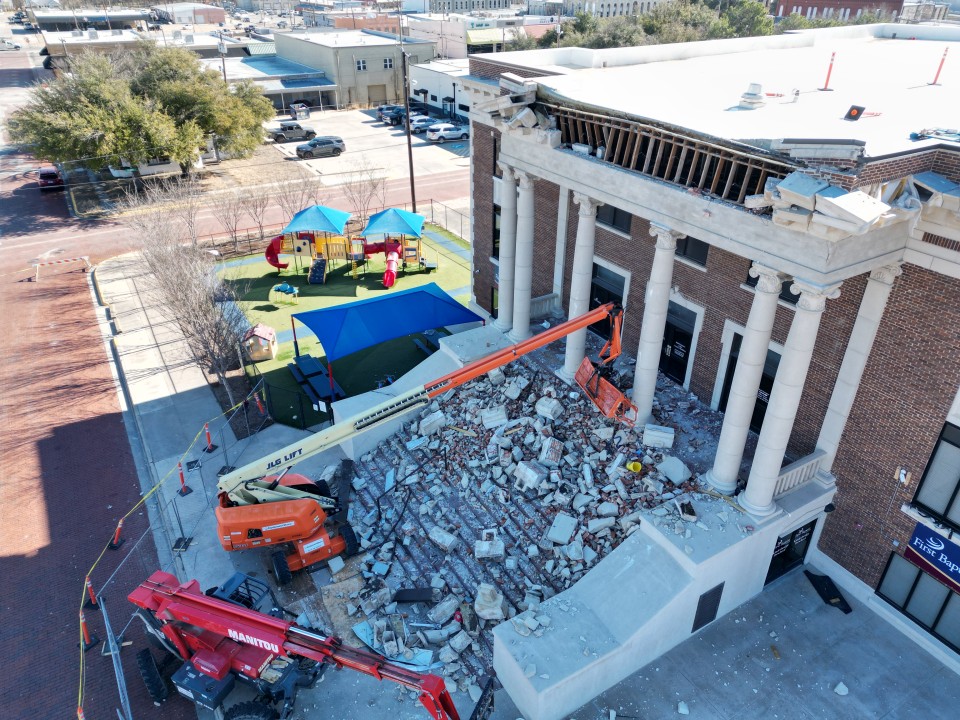
Masonry restoration involves loose material by definition: spalled brick, failing mortar, corroded anchors, cracked stone, unstable cornices.
Working from a boom lift:
- Increases vibration transferred into the structure
- Encourages awkward body positioning and tool handling
- Makes debris containment harder than on scaffold
- Often leads to poor exclusion zone discipline below
A single dropped brick from height is enough to seriously injure or kill. From a legal standpoint, this is indefensible if proper access planning wasn’t done.
The Cultural Problem: Speed Over Craft
Here’s the uncomfortable truth: boom lifts are often chosen not because they are the safest or best method—but because they are faster and cheaper in the short term.
Scaffold:
- Slower to erect
- More planning required
- Forces better work sequencing
- Encourages inspection of substrate as you go
Boom lift:
- Faster access
- Less discipline
- Easier to cut corners
- Greater temptation to “just reach a little further”
This cultural tradeoff—speed over methodical craft—is where most accidents are born.
Best Practices That Actually Reduce Risk (Not Just Look Good in a Safety Manual)
If boom lifts are used at all on masonry restoration projects, serious operators should be doing the following as standard, not optional:
- Formal ground assessment before placement (not visual guessing)
- Load-spreading mats under all tires and outriggers
- Documented minimum clearance distances from power lines
- Strict wind speed thresholds enforced (not ignored)
- Exclusion zones physically barricaded, not “assumed”
- Operator training specific to aerial lifts in restoration environments
- Tool tethering and debris containment planning
- Refusal to use boom lifts where scaffold would be safer
Anything less is theater.
Conclusion: The Tool Isn’t the Problem—The Thinking Is
Boom lifts are not inherently evil. But they are routinely misapplied in masonry restoration by contractors who do not understand the structural, environmental, and historical complexities of the work.
Every serious accident involving a boom lift was preventable. Not with more paperwork—but with better judgment, deeper training, and respect for the physics involved.
If your restoration strategy prioritizes convenience over control, the project is already compromised.
Sources
https://www.osha.gov/aerial-lifts
https://www.osha.gov/electrical/overhead-power-lines
https://www.cdc.gov/niosh/topics/falls/aeriallift.html
https://www.cpwr.com/research/research-to-practice-r2p/aerial-lift-safety/
https://www.scaffold.org/page/AerialLiftSafety